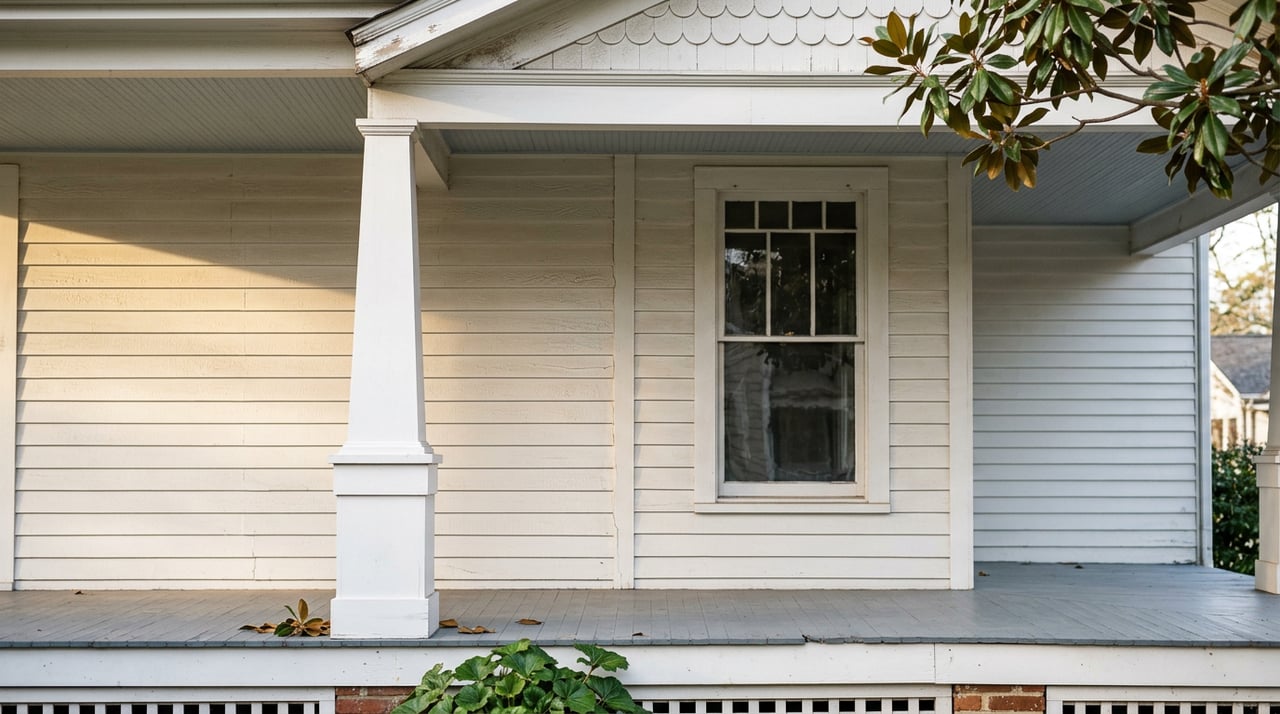
Buyers who fall for a Heights bungalow usually brace themselves for one set of rules: the historic district. They ask about window replacements, roof pitch, paint colors, exactly what the Houston Archaeological and Historical Commission will and won't sign off on. Then the title company runs its search during the option period, and a second set of rules shows up, one that predates the city's involvement entirely and lives in a completely different file at the county clerk's office. Two rulebooks, two referees, and only one of them shows up on a zoning map.
That's the part of buying in the Heights that catches people off guard. Everyone braces for the Houston Archaeological and Historical Commission. Almost nobody asks about the paperwork sitting quietly in the county clerk's office. Once you understand which system actually causes delays, the whole renovation timeline gets a lot easier to plan around.
Any exterior change to a designated historic property in Houston, from a new addition to a window swap, requires a Certificate of Appropriateness from the Houston Archaeological and Historical Commission, a 13-member appointed body that also reviews landmark and historic district designations. That sounds like a bottleneck. In practice, most of it moves faster than reputation suggests.
The commission's own May 2026 meeting minutes show the April 2026 reporting cycle alone brought in 46 new COA applications and 3 pre-application design reviews, pushing year-to-date totals through April to 163 COA submissions and 24 pre-application reviews. Staff approved 17 of those applications administratively in that single cycle, bringing the year-to-date administrative approval count to 48. Close to a third of everything filed so far this year never needed a hearing at all. It went to staff, got a stamp, and moved on.
That matters for anyone budgeting a timeline. A garage rebuild filed in April 2026 at 1521 Columbia Street in Heights East is a useful real example: a contributing 1925 bungalow on a standard 50-by-132-foot lot, proposing a new detached two-story accessory structure, reviewed against the same compatibility criteria (setback matching, height limits tied to the surrounding block) that apply to any new construction in the district. Full commission review, filed under the standard rules, with an application deadline the city sets at 22 calendar days before the meeting. Predictable, if you build the calendar around it.
Here's where the Heights gets more complicated than most historic neighborhoods. Seven separate areas carry historic district status inside the greater Heights footprint: Houston Heights East, West, and South, plus Woodland Heights, Norhill, Freeland, and Germantown. Of those seven, only Heights East, West, and South have written, published design guidelines that spell out what the commission is checking for.
The other four don't have a formal rulebook. Staff and commissioners lean on the same standards used in the three documented districts, but without a written guide behind it, review in those areas is more subjective. That's not a reason to avoid a house in Norhill or Woodland Heights. It's a reason to ask your agent or a preservation-savvy architect to walk the specific block before you assume a renovation plan that worked two streets over will sail through review on yours.
The city's Heights boundary page is the place to confirm which of the seven districts a specific address falls into, and whether the structure on it is even classified as contributing. Not every home inside a historic district counts as one. A 1960s infill house sitting between two 1910 bungalows may carry none of the same review requirements.
Deed restrictions in the Heights predate most of the historic overlay and answer to a different authority entirely. Because the Heights was its own incorporated municipality before 1900, the Texas Property Code carved out a specific chapter, Chapter 208, that gives the Houston Heights Association itself the authority to draft, maintain, and enforce deed restrictions across the original Heights plat. That's not how it works in most Houston subdivisions, where deed restrictions are simply private covenants enforced through civil court. Here, a nonprofit civic association holds that pen, and the restrictions can be amended only if 75 percent of voting owners agree.
The historic overlay and the deed restrictions are separate systems, and when they conflict, the more restrictive one wins. A project can clear HAHC review and still stall because it runs into a deed restriction the city never had jurisdiction over in the first place. The classic example that trips up gut renovators: original shiplap inside a Heights bungalow can't be removed, but it can be covered with sheetrock. That's a deed-restriction-era preservation instinct, not a HAHC design standard, and it's easy to miss if your contractor is reading only the city's guidelines.
There's no neighborhood-wide HOA layered on top of any of this. Civic organizations like the Houston Heights Association and the Woodland Heights Civic Association weigh in on planning and development questions and offer informal design feedback, but they don't collect dues or run an architectural review board the way a master-planned community's HOA would. The deed restrictions and the historic overlay are the actual rules. Everything else is guidance.
Renovation math in a Heights historic district runs on its own scale. A cosmetic refresh on a sound bungalow, paint, finishes, a light kitchen or bath update, typically lands in the $50,000 to $120,000 range. A mid-level renovation touching the kitchen, baths, electrical, and a selective addition runs $200,000 to $400,000. A full gut-and-restore with historic-district compliance built in can reach $500,000 to $1 million or more depending on scope. Compliant projects tend to carry a 15 to 25 percent premium over equivalent work on a non-overlay home, largely from the COA review timeline and the cost of matching approved materials.
That premium buys something back. Any project that receives an approved Certificate of Appropriateness qualifies for a 50 percent discount on building permit fees and may be eligible for a city tax exemption tied to historic rehabilitation. Denied applications get none of it, which is one more reason to loop in the city's Historic Preservation staff during the design phase rather than after plans are drawn.
The durability of all of this isn't in question. When two Heights homeowners challenged the legality of the city's preservation ordinance, the Texas Supreme Court upheld it in 2021, affirming protections that apply to roughly 7,500 structures citywide, including about 2,000 across the Heights East, South, and West districts. The rules aren't going anywhere. Planning around them is the only real option.
A short list worth working through before contingencies come off the table:
None of this replaces a conversation with a real estate attorney or title company about how a specific restriction applies to a specific lot. It does mean you walk into closing knowing which system actually governs the changes you want to make, and which one just looks like it does.
Does historic designation automatically raise my property taxes? No. Designation itself doesn't trigger a reassessment. Renovations and improvements can affect valuation the way they would on any property, historic or not.
If my house isn't in one of the seven mapped historic districts, could it still carry a deed restriction? Yes. Plenty of Heights properties carry deed restrictions independent of historic district boundaries. Checking the title and the Houston Heights Association's list is the only way to know for sure.
Can I always tell what's "contributing" just by looking at the house? Not reliably. Infill construction and heavily altered older homes sit inside historic districts without contributing status, which changes what review applies. The city's district inventory is the source to check, not a guess from the curb.
Buying or renovating inside a Heights historic district rewards the kind of local knowledge that comes from having walked this process with other families, not just reading the ordinance once. If you're weighing a Heights property and want a clear-eyed read on what a specific address actually requires, New Heights Group is glad to help you sort it out before you're locked into a contract. Let's talk about your next move.
New Heights Group delivers outstanding service, personal attention, and results to grateful clients. Contact them today!
Contact UsAddress
4200 Westheimer Rd., #1000
Houston, TX 77027
New Heights Group