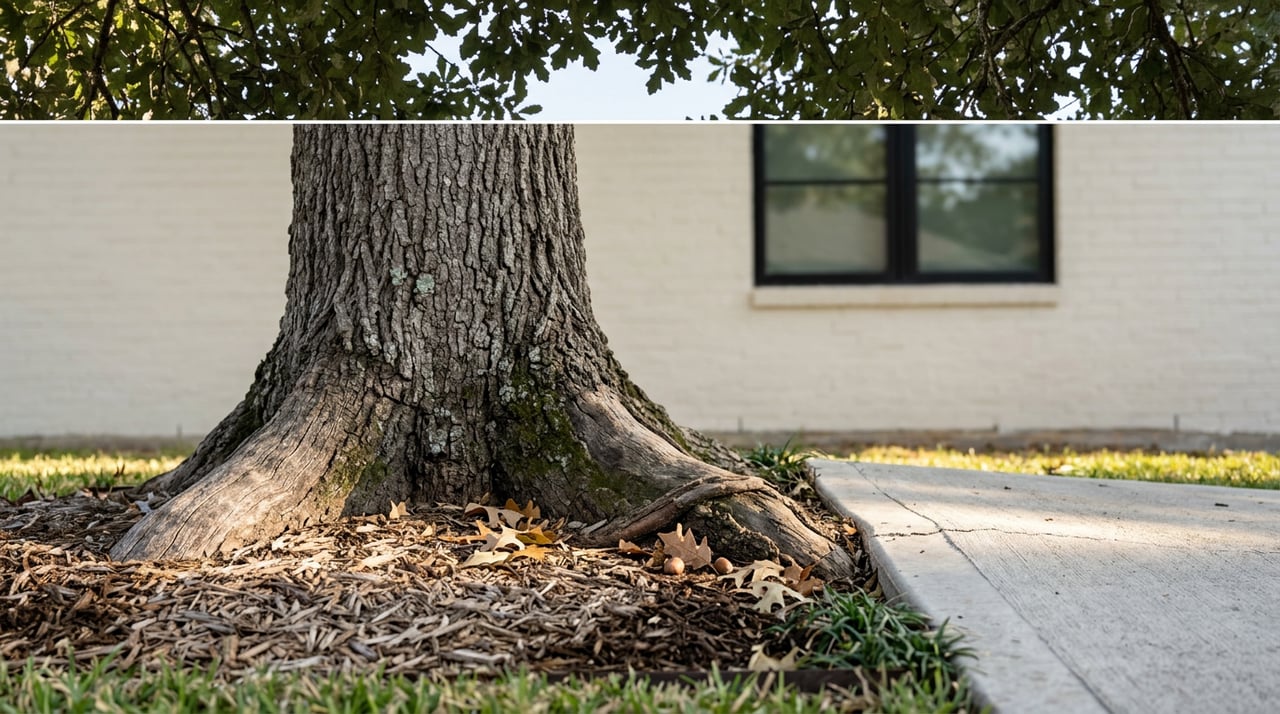
According to ABC13, a West University homeowner hired a tree service in March 2025 to trim eight pecan trees on his property. The crew took the whole canopy off every one of them. When the city found out, it didn't send a warning letter. It sent a bill for roughly $31,000, calculated against the cost of replacing eight mature pecans, because West University's ordinance only allows a limited share of a tree's canopy to be removed without a permit, and this job blew past it in every direction.
That story ran last summer, and it's worth sitting with before you sign a contract on a West U lot with any intention of renovating, adding on, or tearing down. Everyone who has priced a custom home in this city already knows about the setback matrix and the lot coverage caps; Saadi Construction Group identifies the 35-foot height limit, and these constraints force most rebuilds into a three-story stacked footprint on a standard 50-foot-wide lot. Builders quote it, architects design around it, and buyers hear about it before they ever make an offer. Tree requirements are another factor buyers and builders should account for early.
West University Place runs its own building department, separate from the City of Houston, with its own setback and lot-coverage rules for new construction. Front setbacks typically run 20 to 25 feet, side yards 5 feet, and rear yards 20 feet, which is why most rebuilds go up instead of out. A clean first submittal for a single-family custom home usually clears the city in four to eight weeks.
Trees run on a different track entirely, with a different reviewing body and a different trigger. The construction permit reviews your plans. The tree ordinance reviews what's already standing on the lot, and it doesn't care what your architect drew. West University Place's Tree Removal page says an application is required to remove any tree in West University, full stop, regardless of size or species. According to West University Place's Tree Disposition page, if you're planning a pool, an addition, or a full rebuild, the city also requires a separate tree disposition report describing every tree on the property, what's being removed, and how the rest will be protected during construction, at a fee of $250 for large construction and pool projects. Any healthy tree that comes down has to be replaced before the house can be finaled, and the root zones of trees you're keeping have to be enclosed in six-foot chain-link fencing for the duration of the build.
That second track just got stricter. On March 9, 2026, West University Place City Council voted 3-2 to update the city's tree ordinance, switching how trees are measured from circumference to diameter and redefining a "large tree" as one with a trunk diameter of six inches or more. Council members Clay Brett and Kalie Rainsberger voted against the changes after Rainsberger raised questions about how far the city should go in regulating private property. The city's urban forestry consultant, Craig Koehl, and staff explained the reasoning in plain terms. Community Impact quoted an official as saying, "Circumference can be challenging to explain to homeowners at times, so diameter is a little more straightforward." The update also raised penalties for damaging or removing protected trees to a misdemeanor with fines up to $2,000, and a second reading was still pending when the vote was reported, so the exact rollout is worth confirming with the city before you finalize a renovation timeline.
Sources describe the pruning threshold differently. The city's own FAQ page states that removing more than 30 percent of a tree's foliage can trigger a permit requirement, while officials in the homeowner's case cited a 25 percent limit. Because the sources cite different thresholds, confirm the applicable pruning limit and permit requirement with the city before work begins.
The Building Standards Commission, the board that handles code appeals and variances, isn't just theoretical for tree issues. A docket from earlier this year involved homeowners at a West University property seeking a variance to rebuild a fence in the city's right-of-way, and the case turned almost entirely on a tree. An arborist had recommended against moving the fence, arguing that digging near the tree's critical root zone, already stressed from prior utility pruning by CenterPoint, could kill it or create a safety hazard. Board members weighed in with their own experience of contractors accidentally severing irrigation lines during root-zone work, and ultimately treated the city's proposed alternative as a bigger risk than leaving the fence where it stood.
Read that case for what it actually shows. This wasn't a dispute about a new construction plan or a setback exception. It was a fence, arguably the most minor structure in the residential code, and it still required expert arborist testimony and a public hearing because a tree's root system was involved. If a fence variance can pull in that much scrutiny, a full teardown with a mature canopy on the lot deserves the same seriousness from day one, not as an afterthought once the framing crew shows up.
West University teardowns already run on tight margins between land cost and build cost. Buyers are commonly paying $600,000 to $1.5 million just for the existing-home lot, then committing another $1 million to $4 million to build. Against numbers like that, a $250 tree disposition fee looks trivial. A $31,000 replacement bill, a stalled permit while a variance works through the Building Standards Commission, or a redesign forced by an unsurveyed root zone can have a much greater impact.
The permitting reality backs this up directly. A standard residential permit clears in four to eight weeks, but tree removal permits, floodplain review, or drainage exceptions can each add two to four more weeks on top of that. If a lot has a large protected tree sitting where the garage or the addition needs to go, that timeline extension isn't hypothetical. It's the difference between a spring groundbreaking and a summer one.
If you're under contract on a West University property with renovation or rebuild plans, these steps can help you understand the tree-related requirements before closing.
Do I need a permit to trim my own tree in West University? Normal pruning generally doesn't require a permit, but removing a large share of a tree's canopy does, and the city has enforced that line with real financial penalties. If you're unsure how much you're planning to remove, ask the city's Development Services office before the crew shows up.
What changed in the March 2026 ordinance update? The city redefined a "large tree" using trunk diameter instead of circumference, set the threshold at six inches, and raised penalties for violations to a misdemeanor with fines up to $2,000. A second reading was still pending as of the vote, so it's worth confirming the ordinance's current status with the city directly.
Does this apply if I'm tearing the whole house down anyway? Yes. A full teardown still requires a tree disposition report identifying every tree on the lot, what's being removed, and how remaining trees will be protected during construction. Healthy trees that come down have to be replaced before the new house can be finaled.
West University's rules on setbacks, lot coverage, and height get discussed in every builder consultation and most buyer showings. The tree ordinance is another consideration when evaluating a lot for renovation or a rebuild. It's worth walking through those requirements with someone who works this market regularly as part of your due diligence.
New Heights Group works with West University buyers and owners through exactly this kind of due diligence, from evaluating a lot's renovation potential to connecting clients with the right local resources before an option period runs out. Let's talk about your next move.
This article is general information, not legal, tax or financial advice. Consult a qualified professional about your situation.
New Heights Group delivers outstanding service, personal attention, and results to grateful clients. Contact them today!
Contact UsAddress
4200 Westheimer Rd., #1000
Houston, TX 77027
New Heights Group